

How to Handle a Solar Lease When Buying a Home in Palm Desert
Solar is common across the Coachella Valley, and it can be a real advantage in Palm Desert, Rancho Mirage, La Quinta, and Palm Springs—especially when summer electric bills spike. The issue isn’t the panels. The issue is the paperwork.
If you’re buying a home with solar and the system is not owned free-and-clear, the solar agreement can create delays, surprise monthly obligations, or even a loan denial if it’s handled late. Below is a practical, escrow-friendly way to handle a solar lease (or PPA) so you know what you’re taking on and you keep the purchase moving. If you are comparing properties with different solar arrangements, start by reviewing current Palm Desert homes for sale and confirm whether each system is owned, leased or covered by a power purchase agreement before preparing an offer.a
1) The problem: Solar can be a benefit, but the contract can derail escrow
A solar lease is a separate contract from the home purchase. In many cases, the buyer must qualify with the solar company, sign an assumption/transfer package, and accept the remaining term and payment schedule. That process has its own timeline and requirements.
Where deals get messy is when solar is treated like “just another feature” instead of a contract with a third party. Common outcomes when it’s ignored until late escrow:
– The buyer discovers the monthly payment is higher than expected.
– The solar company needs a credit check and the buyer doesn’t qualify.
– The transfer package takes longer than the contingency period.
– The lender flags the solar payment as a debt obligation, changing DTI.
– The buyer and seller disagree on who pays transfer fees or repairs.
Solution: treat solar like a mini-transaction inside the transaction—identify the type, gather documents early, and align the timeline with escrow. Brenda’s Palm Desert buyer resources explain the broader purchase process, including financing, inspections, escrow, negotiation and closing.
2) Step 1: Identify what you’re actually buying (owned vs lease vs PPA)
Before you negotiate price, credits, or repairs, you need to know which of these applies:
A) Owned solar (best-case simplicity)
– The seller owns the system outright.
– There may still be warranties and monitoring accounts to transfer, but there’s no third-party payment contract.
B) Solar lease
– You pay a fixed monthly lease payment (often with an annual escalator).
– The solar company owns the equipment.
– You typically assume the remaining term.
C) Power Purchase Agreement (PPA)
– You pay per kWh produced at a contract rate (often with an escalator).
– The solar company owns the equipment.
– Your bill depends on production and usage patterns.
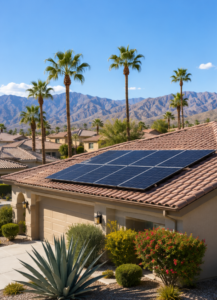 Why this matters in Palm Desert: buyers often compare homes by “monthly cost.” A lease/PPA changes the monthly picture, and it can change how a lender underwrites the file.
Quick way to confirm: ask the listing agent for the solar contract type and the most recent solar statement. If the seller receives a bill from a solar company, it’s almost never “owned free and clear.”
3) Step 2: Collect the right documents early (before contingencies run out)
If you’re the buyer, you want these items as early as possible—ideally when you write the offer or immediately after acceptance:
– The full solar lease or PPA agreement (not just a summary page)
– The current payment amount and any annual escalator schedule
– Remaining term length and end-of-term options
– Transfer/assumption requirements and fees
– Production data (if available) and monitoring access info
– Proof of permits/final inspection sign-off (or documentation of grandfathered status)
– Any roof warranty info and solar installation warranty info
Why early matters: in a fast-moving escrow, your inspection and loan contingencies can expire before you’ve had a chance to review the solar obligations. If the solar company takes 10–20 days to process a transfer, you don’t want to be learning that on day 16. When a property is receiving competing offers, include the solar review and transfer timeline in your Palm Desert multiple-offer strategy so the proposed contingency periods remain both competitive and achievable.
Local note: in desert climates, roof condition matters. If the roof needs work, removing and reinstalling panels can be expensive and may require coordination with the solar company. Getting clarity early helps you negotiate the right solution.
4) Step 3: Confirm transfer/assumption requirements and timelines
Most solar companies have a defined transfer process. The buyer may need to:
– Submit an application
– Provide identification and sometimes income documentation
– Consent to a credit check
– Sign assumption/transfer documents
– Set up a new payment method
Key questions to ask (and get answered in writing if possible):
– How long does the transfer typically take right now?
– Is there a transfer fee? Who pays it?
– What credit score or qualification standards apply?
– Can the seller remain responsible if the buyer doesn’t qualify? (Often no.)
– Are there any past-due amounts or liens associated with the solar contract?
If the buyer might not qualify, you need a Plan B before you’re deep into escrow. Plan B is usually one of these:
– Seller pays off the solar contract at closing (if payoff is allowed)
– Seller replaces the lease/PPA with owned solar (rare mid-escrow)
– Buyer and seller renegotiate price/credits and buyer chooses to proceed only if approved
5) Step 4: Protect your financing, appraisal, and insurance
This is where solar can quietly change the deal.
Debt-to-income (DTI) and underwriting
Some lenders treat a solar lease payment like a recurring obligation similar to a car payment. That can affect DTI and the maximum loan amount. If you’re close to qualifying, the solar payment can be the difference between “approved” and “needs changes.”
Solution: disclose the solar payment to your lender early and provide the contract. Don’t wait for underwriting to “discover” it.
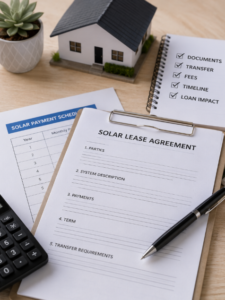 Appraisal expectations
Owned solar can sometimes contribute to value, but leased solar typically does not add the same value because the buyer is also taking on a payment obligation and does not own the equipment.
Solution: don’t assume solar automatically increases appraised value. Price the home based on comparable sales and treat leased solar as a utility-cost factor, not guaranteed equity. Buyers should also understand what happens after a low appraisal in Palm Desert before agreeing to cover an appraisal shortage or contribute additional cash.
Insurance and roof considerations
Your homeowner’s insurance agent may ask whether the system is owned or leased and whether it’s attached to the roof. If there’s roof work needed, you’ll want to know who is responsible for panel removal/reinstall and whether the solar company must do it.
Solution: during inspections, pay attention to roof condition, attic heat/ventilation, and any signs of prior leaks around penetrations. If the roof is near end-of-life, negotiate the fix before you take over a long-term solar contract.
6) Step 5: Negotiate smart solutions (seller payoff, credits, or transfer terms)
Once you understand the contract, you can negotiate in a way that keeps the deal intact.
Option A: Seller pays off the solar lease/PPA (if allowed)
Pros:
– Cleanest for the buyer
– Simplifies underwriting and closing
Cons:
– Payoff can be large and not always permitted or straightforward If a payoff is being considered, the seller can use a Palm Desert seller net sheet to estimate how the solar payoff and other closing expenses could affect expected proceeds.
Option B: Buyer assumes the lease/PPA, but you negotiate credits or price
Pros:
– Keeps the transaction moving
– Shares the cost impact
Cons:
– Buyer still takes on the long-term obligation
Option C: Seller provides proof of transfer approval as a condition
Pros:
– Reduces risk of last-minute failure
Cons:
– Requires tight timelines and cooperation
What I typically recommend in Coachella Valley transactions is aligning the solar timeline with your contingency timeline. If the solar company needs two weeks to approve a transfer, your contract strategy should reflect that reality so you’re not forced to remove contingencies before you have answers. Sellers preparing to transfer or pay off a solar agreement can also review Brenda’s Palm Desert seller resources before listing or negotiating an accepted offer.
A practical checklist for buyers (use this before you remove contingencies)
– Confirm: owned vs lease vs PPA
– Read: payment amount, escalator, remaining term
– Confirm: transfer steps, fees, and processing time
– Provide: contract to your lender early
– Inspect: roof condition and any solar-related penetrations
– Decide: assume vs request payoff vs negotiate credits
– Document: who pays transfer fees and what happens if buyer can’t qualify
Why this matters specifically in Palm Desert and nearby cities
Many buyers here are balancing second-home timing, remote closings, and seasonal occupancy. A solar transfer that requires signatures, ID verification, or credit approval can be a bigger headache when you’re not local. Planning early prevents a “we’re ready to close, but solar isn’t transferred” delay—especially common when buyers are traveling or coordinating from out of state.
If you’re looking at a home in Palm Desert, Indian Wells, Rancho Mirage, La Quinta, Indio, Palm Springs, or Sun City Palm Desert and it has solar, the best move is to treat the solar agreement like a key part of your due diligence—not an afterthought.
Handled correctly, solar can still be a win: predictable energy costs, better comfort in summer, and one less thing to worry about when the desert heat arrives. The goal is simply to make sure the contract matches your budget, your financing, and your timeline—before you’re committed.
Buying or selling a home with solar in Palm Desert or the greater Coachella Valley? Contact Brenda Devlin, Realtor, to review the solar paperwork early, coordinate timelines with escrow, and keep your transaction on track. (760) 408-8588 https://brendadevlin.com/