
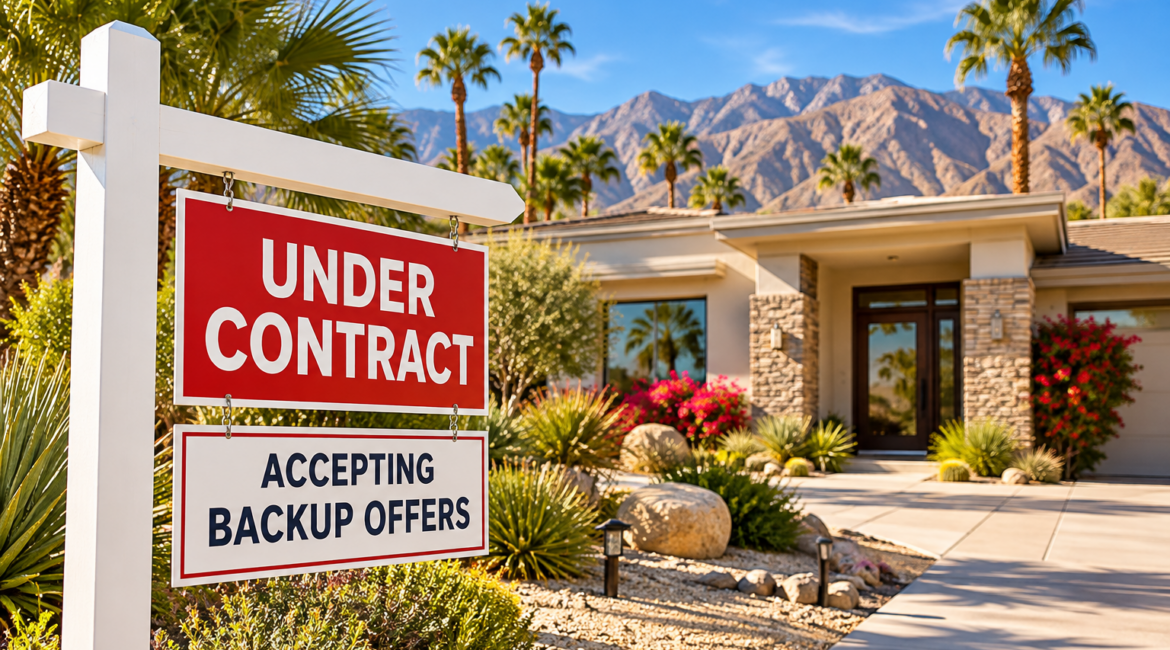
You find the right place in the Coachella Valley—maybe a Palm Desert condo close to El Paseo, a Rancho Mirage home with a great yard, or a La Quinta property that checks every box. You ask your agent to schedule a showing and hear the words no buyer wants to hear: “It’s already under contract, but the seller is accepting backup offers.”
That moment creates a very specific problem: you want a real shot at the home, but you don’t want to get used as leverage against the current buyer, tie up your money and time, or miss other opportunities in Palm Springs, Indian Wells, Indio, or Sun City Palm Desert while you wait.
Below is a practical, Coachella Valley–specific way to handle a backup offer request so you stay competitive without giving away your leverage.
The problem: You love the house, but it’s already “under contract”
In our local market, “under contract” can mean a few different things. Sometimes the buyer is solid and just moving through inspections and appraisal. Other times, the deal is fragile—financing is shaky, the buyer has a home sale contingency, the HOA documents are a mess, or inspection findings are turning into a negotiation.
Sellers and listing agents often keep showing and invite backup offers for one reason: they want certainty. A strong backup offer can reduce the chance the seller has to start over if the first buyer cancels.
But for you as a buyer, a backup offer can become a trap if you:
– Stop looking and lose momentum.
– Agree to terms that make you “stuck” if the first deal doesn’t fall apart quickly.
– Reveal too much about your willingness to pay or your flexibility.
The solution is to treat a backup offer like a controlled, time-bound strategy—not a hopeful placeholder.
Step 1: Confirm what “under contract” really means (and what can still happen)
Before you write anything, your agent should gather facts. Not gossip—facts.
Key questions to ask the listing side:
– What is the current status? (Active Under Contract, Pending, or something else in the MLS?)
– Are contingencies still in place? Inspection? Appraisal? Loan? HOA review? Solar review?
– Has the buyer removed any contingencies yet?
– Is there a home sale contingency involved?
– What is the seller’s ideal backup scenario? (Higher price? Faster close? Fewer contingencies?)
– Are there known issues: HOA restrictions, rental caps, special assessments, insurance challenges, or permit questions?
In the Coachella Valley, the “HOA factor” is huge—especially in Palm Desert, Indian Wells, Rancho Mirage, and La Quinta, where many communities have detailed rules and document packages. If the first buyer is still reviewing HOA docs, that’s a common point where deals wobble.
Also, if the home is a condo, the first buyer may be navigating lender requirements, insurance details, and association documentation. That can create delays or cancellations that a seller wants protection against.
Your goal: understand whether you’re likely waiting two days, two weeks, or two months—and whether the first buyer is actually at risk of falling out.
Step 2: Build a backup offer that’s strong without overcommitting
A backup offer should be attractive to the seller but structured to protect you.
A) Price and terms: be compelling, not reckless
If you truly want the home, your offer should be clean and credible. That doesn’t always mean the highest price. In many Coachella Valley transactions, sellers value:
 – Proof of funds that matches the down payment and closing costs.
– A reputable lender with a strong pre-approval (not just a pre-qualification).
– A realistic timeline.
– Fewer “unknowns” (like a buyer who must sell another property first).
If you’re competing as a backup, you can sometimes win by being the “easy yes” if the first deal fails.
B) Keep contingencies reasonable, but don’t remove them blindly
Some buyers think a backup offer must waive everything. That’s rarely necessary and can be dangerous.
Instead, consider:
– Standard inspection contingency (you still need to know what you’re buying).
– Loan contingency if you’re financing.
– HOA document review contingency if it’s an HOA community (common across the Valley).
The key is to shorten timelines where you can, and be clear you can perform.
C) Add a time boundary
One of the biggest leverage killers is an open-ended backup offer that ties you up. Your offer can include a requirement that the seller provide written notice if the primary contract cancels, and that your backup position converts within a defined window.
In plain terms: you’re willing to be next in line, but not indefinitely.
D) Consider a “right to continue shopping” approach
In many situations, you can continue viewing and even writing offers on other homes unless and until your backup position becomes primary. The exact mechanics depend on how the paperwork is written and what you agree to.
This is where careful drafting matters. A backup offer should not accidentally prevent you from pursuing other options in Palm Springs, Indio, or La Quinta while you wait.
Step 3: Protect your leverage: timelines, deposits, and disclosures
Backup offers can create pressure points around money and timing. Here’s how to protect yourself.
A) Earnest money deposit: clarify when it’s due
You don’t want to deliver a deposit too early if you’re not actually in contract as the primary buyer. Your agent should ensure the deposit timing aligns with when your offer becomes effective.
B) Inspection timing: don’t start spending until you’re primary
It’s tempting to “get ahead” by ordering inspections immediately. But if you’re still a backup, you could spend money and never get the house.
A better approach is to be ready to schedule inspections quickly the moment you convert to primary. In the Coachella Valley, good inspectors can book up—so planning ahead is smart, paying ahead is not.
C) Disclosures and HOA docs: request them early, review them smartly
Even as a backup, you can often request disclosures and (if applicable) HOA documents so you’re not starting from zero later.
For HOA communities common in Palm Desert, Rancho Mirage, Indian Wells, and Sun City Palm Desert, pay attention to:
– Rental restrictions and any rental cap.
– Pet rules.
– Insurance responsibilities and deductibles.
– Pending litigation (if any).
– Special assessments or reserve funding concerns.
If something in the documents would be a deal-breaker, it’s better to know before you’re emotionally invested.
D) Appraisal and financing: avoid giving away your ceiling
If you’re financing, be cautious about language that signals you’ll cover any appraisal gap without limits. In a backup situation, you want to be competitive, but you also don’t want to broadcast that you’ll pay any price just to win.
A balanced approach is to discuss with your agent and lender what you can truly support and structure your offer accordingly.
Step 4: Communication plan: how your agent should position you with the listing side
A backup offer is as much about positioning as paperwork.
What works locally:
– Clear proof you can close: strong pre-approval, responsive lender, proof of funds.
– A concise buyer “profile”: why you love the home, your timeline, and your reliability.
– Fast responsiveness: if the listing agent asks for a signature or clarification, delays make you look uncertain.
What to avoid:
– Over-sharing your maximum price or desperation.
– Threatening language (“take it or leave it”).
– Constant check-ins that annoy the listing side without adding value.
A good approach is for your agent to set expectations: you’re serious, you’ll stay ready, and you’ll move quickly if the first deal cancels. That’s exactly what the seller wants from a backup.
Also, your agent should try to learn (without prying) what the seller is worried about in the current deal. If the first buyer is struggling with financing, your strong lender matters. If the first buyer is negotiating repairs, your willingness to handle minor items may matter. If the first buyer has a long contingency period, your shorter timeline matters.
Step 5: When to walk away (and how to keep your search moving)
Not every backup offer is worth it.
Consider walking away if:
– The listing side won’t share any meaningful status and wants you tied up anyway.
– The seller wants you to waive protections that don’t make sense for the property type (especially condos/HOAs).
– The timeline is too uncertain and you’re missing other opportunities.
– The home has a known issue (HOA, insurance, condition) and you’re being asked to accept it without proper review.
A smart backup strategy includes a parallel plan:
– Keep touring homes in Palm Springs, Palm Desert, Rancho Mirage, La Quinta, Indio, and Indian Wells.
– Stay ready to write a clean primary offer elsewhere.
– If you do go into backup position, set a check-in schedule with your agent based on the primary buyer’s contingency deadlines.
In many cases, the best leverage you have is the ability to move on. Ironically, that’s also what makes your backup offer stronger: you’re not stuck, and you’re not bluffing.
Putting it all together
A backup offer in the Coachella Valley can be a winning move—especially when a property is highly desirable and the first contract has real friction points (inspection negotiations, HOA review, financing, appraisal). The key is to treat it as a structured plan:
– Verify the real status and risk.
– Write a clean offer with smart protections.
– Control your timelines and deposit exposure.
– Position yourself as the easy, reliable next buyer.
– Keep your search active so you don’t lose leverage.
If you want, I can help you evaluate whether a specific backup offer is worth pursuing and how to structure it based on the neighborhood, property type, and what’s happening in the current contract.