
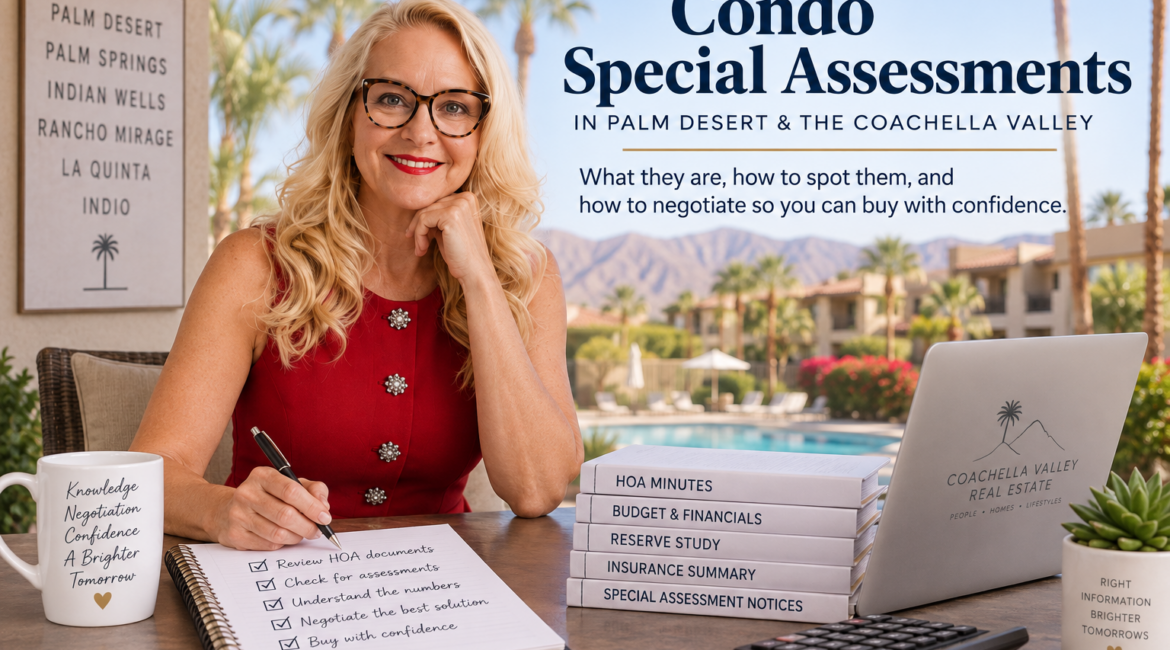
A special assessment is one of the fastest ways a condo purchase can go from “this fits perfectly” to “wait… what did we just agree to?” In the Coachella Valley—Palm Desert, Palm Springs, Indian Wells, Rancho Mirage, La Quinta, Indio—many condo communities have shared roofs, shared plumbing lines, shared pools/spas, and shared exterior systems. When a big repair or upgrade is needed, and reserves aren’t enough (or the board chooses not to use them), owners can be charged an additional one-time amount or a temporary monthly increase.
The problem isn’t that special assessments exist. The problem is buyers often learn about them too late, misunderstand what they’re actually paying for, or fail to negotiate the cost in a way that protects their cash flow.
Below is a practical, step-by-step way to handle a Palm Desert condo special assessment so you can keep your budget intact and still move forward confidently when the condo is the right fit. Buyers who are still comparing communities and property types can review current Palm Desert homes for sale before deciding which condo options justify a detailed HOA and financial review.
1) The problem: special assessments can turn a “great deal” into an expensive surprise
When you’re buying a condo, you’re not just buying the unit—you’re buying into a shared financial ecosystem. Even if your inspection looks good inside the walls, the HOA may be planning (or already funding) major work outside your unit.
In real terms, a special assessment can show up as:
– A lump-sum bill due at closing or shortly after (for example, $3,500–$25,000+ depending on the project and community size)
– A monthly add-on for a set period (for example, $150/month for 24 months)
– A “loan repayment” line item if the HOA took a bank loan and is passing payments to owners
In the desert, common triggers include roof replacements, exterior painting, asphalt and private road work, pool/spa replastering, irrigation retrofits, elevator modernization (in some buildings), and insurance premium spikes that outpace the budget. If you are still weighing property types, compare buying a condo versus a single-family home in Palm Desert golf communities because HOA responsibility, exterior maintenance, insurance exposure, privacy and monthly ownership costs can differ substantially.
2) Step 1: Identify whether an assessment exists (and what kind it is)
Before you negotiate anything, you need clarity on what you’re dealing with. Not all assessments are the same, and the strategy changes depending on timing.
Ask these three questions early (ideally before you remove contingencies):
A) Is there a current special assessment?
This is the straightforward one: it’s been approved, and owners are being billed.
B) Is there a proposed or pending assessment?
Sometimes the board has discussed it, obtained bids, or announced it in meeting minutes, but it hasn’t been formally approved yet. This is where buyers get caught—because it may not appear as a current charge on the seller’s statement, but it’s still very real.
C) Is there an HOA loan or planned capital project that functions like an assessment?
Even if the HOA calls it a “capital improvement fee” or “temporary dues increase,” it can impact your monthly payment the same way. For budgeting and lending, treat it seriously.
Practical tip for Coachella Valley condos: If the listing agent says “no assessment,” that may only mean “no assessment currently being billed.” Your due diligence should confirm whether anything is being discussed, voted on, or scheduled.
3) Step 2: Verify the numbers in the right HOA documents (what to request and where to look)
The solution is document-driven. You want to see the assessment in writing, confirm the amount, confirm the due dates, and confirm whether it transfers to the buyer. Use the Palm Desert HOA documents checklist to organize your review of the CC&Rs, reserve study, budget, meeting minutes, assessment history and other records before removing contingencies.
Key documents to request/review (often delivered as part of the HOA resale package):
– HOA demand/statement (shows current dues, any assessment amount, late fees, and what’s owed through closing)
– Budget and year-to-date financials (reveals whether the HOA is running a deficit or relying on “catch-up” measures)
– Reserve study (or reserve summary) and reserve funding plan
– Meeting minutes (board minutes and, if available, annual meeting minutes) for the last 6–12 months
– Insurance summary (large premium increases can foreshadow dues jumps or assessments)
– Any special assessment notices, ballots, or owner communications
Where the “truth” usually shows up:
– Meeting minutes: This is where you’ll see phrases like “roof bids,” “reserve shortfall,” “special assessment discussion,” “loan proposal,” “vote scheduled,” or “project timeline.”
– Reserve study: Look for components that are “fully funded” vs “underfunded,” and note any big-ticket items due soon.
– Budget: If reserves are low and major components are near end-of-life, the risk of an assessment rises.
What to confirm in writing:
– Total assessment amount per unit
– Payment options (lump sum vs monthly)
– Due dates and whether any portion is already paid by the seller
– Whether the obligation runs with the unit (it usually does)
– Whether the HOA requires payoff at closing if there’s a lien or delinquency
If you’re buying in Palm Springs or Palm Desert where some communities have multiple associations (master HOA + sub HOA), confirm whether the assessment is in the master, the sub, or both.
4) Step 3: Evaluate risk: reserves, deferred maintenance, and upcoming projects common in desert communities
Even if you confirm a current assessment, you still want to understand whether it’s a one-time event or a sign of ongoing underfunding.
Here’s a simple risk checklist that’s especially relevant in the Coachella Valley:
– Reserves vs reality: Are reserves consistently funded, or has the HOA been keeping dues artificially low?
– Deferred maintenance: Do minutes mention recurring leaks, repeated patch repairs, or “we’ll revisit next year” language?
– Insurance pressure: Desert communities have seen insurance costs rise; if the HOA is struggling to maintain coverage or has large deductibles, that can affect future costs. A large master-policy deductible can create a separate assessment risk. Review how HOA insurance deductibles and loss assessments can affect Palm Desert condo buyers before assuming an ordinary HO-6 policy will cover every HOA-related charge.
– Age of the community: Many condo communities have aging infrastructure. If roofs, plumbing lines, and asphalt are all near end-of-life, one assessment can turn into a pattern.
– Scope clarity: Is the assessment tied to a defined contract and scope, or is it a vague “we think it will be around…” estimate?
A buyer-friendly way to think about it:
– A well-scoped assessment for a necessary project (with bids, timeline, and clear communication) can be a positive sign of responsible governance.
– A rushed assessment with unclear numbers, minimal documentation, or constant “emergency” language can be a red flag.
5) Step 4: Negotiate solutions: credits, price, payment responsibility, and contingencies
Once you understand the assessment, you have multiple ways to structure a solution. The “right” one depends on the market, the seller’s flexibility, and your cash position.
Common negotiation paths:
A) Seller credit toward closing costs (to offset the assessment)
This can help preserve your cash, but it’s limited by lender rules and your closing cost totals. It’s also not always a dollar-for-dollar solution if the assessment is large.
B) Price reduction
A price reduction can be cleaner for large assessments, but it doesn’t always help your immediate cash flow if the assessment is due soon after closing.
C) Seller pays the assessment (or a portion) at closing
If the assessment is already approved and quantified, you can negotiate for the seller to pay it off (or prepay a set number of months). This is often the most direct way to protect your post-closing budget.
D) Split responsibility based on timing
A fair approach sometimes looks like: seller pays amounts due before closing; buyer assumes amounts due after closing. This must be documented clearly.
E) Keep contingencies in place until documents are reviewed
If the assessment is unclear or pending, the best “negotiation” may be time: do not remove your HOA document contingency until you have the minutes, financials, and any notices in hand. Brenda’s Palm Desert buyer resources explain the broader purchase process, including financing, inspections, document-review periods, escrow and closing.
Important detail: If an assessment is proposed but not approved, negotiating gets trickier. You may not be able to force a seller to pay something that doesn’t officially exist yet. In those cases, you negotiate based on risk—price, credits, or a walk-away right if an assessment is approved before closing.
6) Step 5: Make a go/no-go decision with a simple budget stress test
Even after negotiating, you should run a quick stress test so you don’t end up “house rich and cash poor.”
Use this simple framework:
– Start with your monthly housing payment (mortgage + property taxes + insurance)
– Add HOA dues
– Add any assessment payment (monthly equivalent)
– Add a buffer for HOA dues increases (many buyers use 5–10% as a planning number)
Then ask:
– If this payment rises by $200–$400/month, does it still feel comfortable?
– If the HOA announces another project next year, do you have reserves (personal savings) to handle it?
– If you’re buying as a second home, can you carry the cost during months you’re not using it?
In Palm Desert, Rancho Mirage, and Indian Wells especially, buyers often choose condos for lifestyle and convenience. If you have not yet selected a community, use the Palm Desert gated community map to compare locations, property types and community structures. After narrowing the search, review the financial and assessment records for every HOA you seriously consider.The best outcome is when the financial side supports that lifestyle instead of creating ongoing stress.
Putting it all together
Handling a Palm Desert condo special assessment comes down to three things: (1) confirming what’s real in the documents, (2) understanding whether it’s a one-time fix or a symptom, and (3) negotiating the cost in a way that protects your cash flow.
If you do those steps in order, you can avoid the most common mistake: falling in love with the unit and treating the HOA as an afterthought. In condo purchases across Palm Springs, Palm Desert, La Quinta, Indio, and the broader Coachella Valley, the HOA is part of the property.
If you’d like, I can help you review the HOA package and minutes for a specific condo you’re considering and flag the lines that typically signal assessment risk—before you’re locked in.