
A home inspection is supposed to reduce uncertainty. But if your Coachella Valley inspection report comes back with “polybutylene (PB) plumbing present,” it can feel like the deal just tilted sideways—especially if you’ve never heard of it.
In Palm Desert, Rancho Mirage, La Quinta, Indian Wells, Indio, and Palm Springs, it’s not unusual to see older plumbing materials show up in inspections, particularly in homes built or updated during certain decades. The key is to treat a PB note as a solvable transaction issue—not an automatic deal-killer—and to respond with a plan that protects you financially.
Below is a practical, problem-solution approach I use with buyers and sellers so the next steps are clear, the negotiation stays focused, and the transaction doesn’t drift into panic or vague demands.
The problem: Your inspection report says “polybutylene (PB) plumbing”
Polybutylene is a type of plastic plumbing pipe that was commonly used in many U.S. homes for a period of time. Inspectors often flag it because it has a history of failures in certain conditions and, just as importantly, because some insurance carriers treat it as a higher-risk material.
In a real estate transaction, the PB issue usually creates three immediate concerns:
– Leak risk: Buyers worry about hidden failures and future water damage.
– Insurance friction: Buyers worry they won’t be able to insure the home affordably (or at all) without changes.
– Resale/financing friction: Even if you’re comfortable with the risk, a future buyer (and their insurer) may not be.
The solution is not to guess. The solution is to confirm what’s there, quantify the scope, and negotiate based on real costs and real risk.
Step 1: Confirm what’s actually in the home (and how extensive it is)
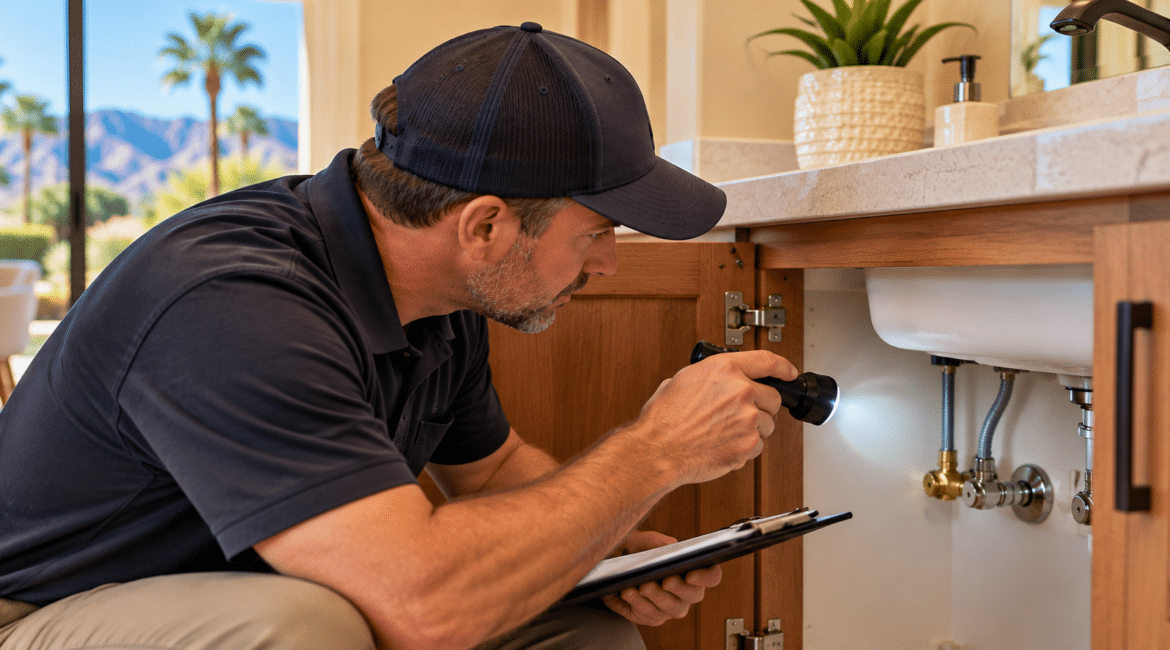
Not every “PB” note means the entire house needs a full repipe tomorrow. Sometimes the inspector sees PB at an accessible point (like the water heater area or under a sink) and flags it as a potential presence elsewhere.
What to do next:
– Ask the inspector where it was observed and how it was identified. Was it clearly labeled PB? Was it gray flexible pipe? Were there PB fittings visible?
– Determine whether it’s supply lines, distribution lines, or isolated sections. PB is typically a supply/distribution piping issue, but you want clarity.
– Check access points: water heater closet, garage, under sinks, laundry, and any visible piping in utility areas.
– Ask the seller (through your agent) for any plumbing invoices, prior leak repairs, or documentation of partial repipes.
If the home is in a condo or planned community (common in Palm Desert, Indian Wells, and Rancho Mirage), also clarify what owner responsibility versus HOA responsibility is. Some communities cover certain plumbing components and not others, and that affects both cost and negotiation.
If the scope is unclear, the clean next move is a licensed plumber evaluation with a written estimate. That turns a scary inspection note into a line item you can negotiate.
Step 2: Understand the real risk: insurance, resale, and leak exposure
PB isn’t just a “plumbing” issue; it’s a risk-management issue.
Insurance: In the Coachella Valley, insurance availability and underwriting guidelines can change quickly. Some carriers may require replacement of PB before binding coverage, while others may insure with conditions or higher premiums. Before you remove contingencies, it’s smart to:
– Call your insurance agent and ask directly: “Will you insure a home with polybutylene plumbing? If yes, under what conditions?”
– Get the answer in writing if possible, or at least document the carrier name and guidance.
Resale: Even if you’re buying a primary residence and plan to stay for years, PB can become a friction point when you sell. Buyers often react strongly to inspection language, and many will ask for replacement or credits.
Leak exposure: The desert climate doesn’t eliminate water damage risk. In fact, many Coachella Valley homes are seasonal or sit vacant for stretches, which can make small leaks more damaging if they go unnoticed. If you’re buying a second home in Palm Springs, La Quinta, or Sun City Palm Desert, this is a practical consideration.
The goal here is not to catastrophize. It’s to decide what level of risk you’re willing to own—and to price that risk correctly in the transaction.
Step 3: Choose a strategy: repair, repipe, credit, or walk-away protections
Once you confirm scope and get at least one written estimate, you can choose a negotiation strategy that matches your timeline and leverage.
Option A: Seller completes replacement (best when time allows)
Pros:
– You take ownership with the issue resolved.
– Insurance and resale concerns are reduced.
Cons:
– Scheduling can delay closing.
– Quality control matters; you want permits where required and a reputable plumber.
If you go this route, specify:
– Work performed by a licensed plumber
– Paid invoice and warranty documentation at closing
– Re-inspection or final walkthrough verification
Option B: Seller credit (common when closing timelines are tight)
Pros:
– Keeps closing on schedule.
– You control the contractor and scope after closing.
Cons:
– Your lender may limit credits.
– Credit must be high enough to cover real costs, not just “something.”
This is often the most practical solution in competitive markets or when the seller won’t do work pre-close.
Option C: Price reduction (less ideal than a credit in many cases)
A price reduction spreads the cost over the loan term, but it doesn’t put cash in your pocket to pay the plumber. For some buyers, that’s fine; for others, it creates a cash-flow problem right after closing.
Option D: Walk-away or contingency protection (when risk is unacceptable)
If insurance is not obtainable on acceptable terms, or if the estimates are high and the seller won’t negotiate, your best protection may be to use your inspection contingency (or other applicable contingency) to cancel.
The “right” option depends on:
– Your leverage (multiple offers vs. slower market)
– Your closing timeline
– Your lender’s credit limits
– Your cash reserves
– Whether this is a primary home, second home, or investment
Step 4: Write a clean request for repairs/credits that keeps leverage
Where deals go wrong is not the existence of PB—it’s the negotiation getting emotional or vague.
A strong request is specific and supported:
– Attach the plumber’s written estimate(s).
– Ask for a defined remedy: “Seller to replace all PB supply lines with [material] by licensed plumber prior to close” or “Seller to credit Buyer $X toward replacement of PB plumbing.”
– Keep it focused on the material issue. Avoid bundling a long list of minor items with a major plumbing request; it can make the seller dig in.
Also, coordinate with your lender before you finalize the request. If you want a credit, confirm the maximum allowable seller credit for your loan type and down payment. A credit that exceeds lender limits can force a last-minute rewrite.
If you’re the seller, the same principle applies: respond with clarity. Provide documentation of prior work, offer a credit aligned with real estimates, and avoid “we’ve never had a problem” as the main argument. Buyers are buying the future risk, not the past experience.
Step 5: Avoid common Coachella Valley deal mistakes with PB findings
Here are the pitfalls I see most often in Palm Desert and across the valley:
Mistake 1: Removing contingencies before confirming insurance
If your carrier won’t insure the home with PB, you don’t want to discover that after you’re locked in. Make the insurance call early.
Mistake 2: Negotiating off fear instead of estimates
A seller credit should be tied to real bids. Without that, you’re guessing—and the other side will treat it like guesswork.
Mistake 3: Assuming “partial replacement” solves everything
Sometimes only visible sections were replaced, leaving PB in walls or attic runs. Confirm the extent with documentation or a plumber’s evaluation.
Mistake 4: Failing to consider vacancy risk
If you’ll be away for long stretches (common in Palm Springs, La Quinta, and Indian Wells), your tolerance for plumbing risk may be lower. That should influence your negotiation.
Mistake 5: Letting the issue stall the transaction
PB can be addressed quickly when you follow a sequence: confirm → estimate → insurance check → negotiate. Delays often come from uncertainty and back-and-forth without documentation.
A PB flag on an inspection report is a moment to get organized—not a reason to assume the worst. With the right verification and a clean negotiation strategy, you can either (1) get the issue resolved, (2) get compensated appropriately, or (3) exit the deal with your protections intact.
If you’re buying or selling in the Coachella Valley and an inspection just raised a PB plumbing question, the fastest path forward is to turn it into a documented scope and a documented cost, then negotiate from there.