

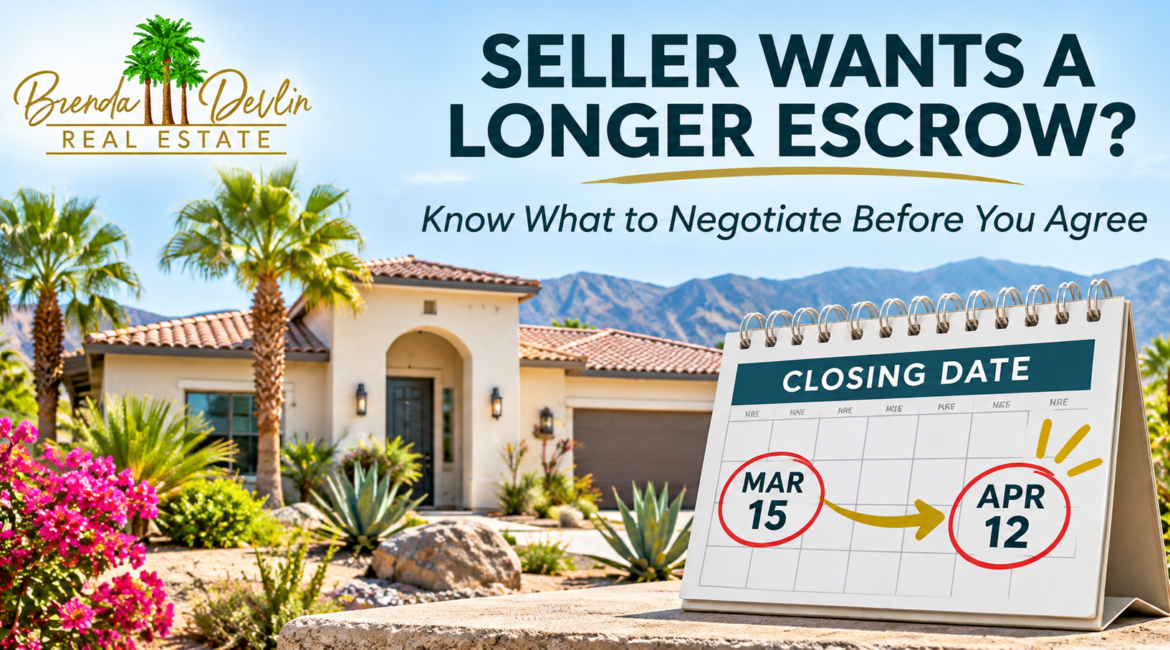
If you’re buying a home in the Coachella Valley and the seller asks for a longer escrow, the real question isn’t “Is a longer escrow normal?” It’s: “What does the extra time cost me, and how do I protect myself while still getting the house?” A longer escrow can be perfectly workable—but only if your financing, contingencies, and negotiation leverage are structured for the longer timeline.
This decision guide walks you through how to evaluate an extended escrow request and what to ask for in return, whether you’re shopping in Palm Desert, Indian Wells, Rancho Mirage, La Quinta, Indio, Palm Springs, or Sun City Palm Desert.
1) The buyer question: should you agree to a longer escrow?
Agreeing to a longer escrow can make sense when (a) the seller has a legitimate timing need, (b) you’re comfortable with the home and the neighborhood, and (c) you can control the risks that come with waiting.
The main risks buyers run into with a longer escrow are:
– Financing risk: rate locks can expire, underwriting conditions can change, or your documentation can “go stale” and need updating.
– Property condition drift: the home can change between inspection and closing (especially if it’s occupied), and seasonal factors can reveal new issues.
– Timeline creep: “Just two more weeks” can turn into repeated extensions if the contract doesn’t set clear boundaries.
– Opportunity cost: you may miss other homes while you’re tied up.
The goal is not to refuse longer escrow automatically. The goal is to make the longer escrow a defined, managed timeline—rather than an open-ended delay.
2) Step 1: Identify why the seller wants more time (and what it changes for you)
Before you respond, get specific about the seller’s reason. “We need a longer escrow” is not enough. Your agent should ask for the driver behind the request, because different reasons call for different protections.
Common seller reasons (and what to watch):
– They’re buying a replacement home. This can be legitimate, but it can also create a chain reaction of delays. Ask whether they’re already in escrow, just starting to look, or waiting on a contingency.
– They need time to move or coordinate a relocation. This is often straightforward if the seller can commit to a firm date.
– They’re waiting on probate/trust/authority to sign. This can be real, but it’s a risk area if the timeline is uncertain. You want clarity on what’s pending and what “done” looks like.
– They want to finish repairs or improvements before closing. This can be fine, but you’ll want to define scope, permits (if applicable), and verification.
What changes for you once you know the reason:
– If the seller’s timeline is uncertain, you need stronger contract milestones and limits on extensions.
– If the seller’s timeline is firm, you can focus on financing and contingency alignment.
– If the seller is asking for time but offering nothing in return, you may need to negotiate value (price, credits, or terms) to compensate for the added risk.
3) Step 2: Protect your financing and rate-lock risk before you counter
For many buyers, the biggest financial exposure in a longer escrow is the mortgage rate lock. You don’t want to discover late in the process that your lock expires a week before closing.
What to do immediately:
– Ask your lender: “How long is my rate lock, what does an extension cost, and when do I need to decide?”
– Ask whether your loan program has timing constraints (for example, document expiration, appraisal validity windows, or re-verification requirements).
– Confirm whether a longer escrow changes your cash-to-close planning (for example, if you’re moving funds, selling investments, or coordinating a sale).
How to structure your offer/counter to reduce financing risk:
– Align escrow length with a realistic lock strategy. If the seller wants a longer escrow, you want a timeline that your lender can support without last-minute surprises.
– Build in a decision point. If you’re going to pay for a lock extension, you may want a contract milestone that triggers that decision (for example, once the seller meets a specific condition).
– Negotiate value if the longer escrow creates measurable cost. If your lender quotes a lock extension fee, that’s a concrete reason to ask for a credit or price adjustment. (Your lender should provide the numbers; don’t guess.)
A practical way to think about it: the seller is asking you to carry more market and financing risk for longer. If you’re going to do that, you want the contract to pay you back in certainty, protections, or concessions.
4) Step 3: Rebuild your contingency and repair timeline to match the longer escrow
A common mistake is agreeing to a longer escrow while leaving the rest of the contract on a short fuse. That’s how buyers end up with expired contingencies, rushed decisions, or confusion about what happens if something changes.
Key timelines to review and adjust:
– Inspection contingency: If you’re doing inspections early, that’s good—but you also want clarity on what happens if the property condition changes before closing.
– Repair requests and completion: If repairs are negotiated, define (a) who chooses the contractor, (b) whether permits are required, (c) what “completion” means, and (d) how you verify completion.
– Appraisal timing: If the appraisal happens early and the escrow is long, ask your lender what happens if the appraisal needs to be updated or re-verified.
– Final walkthrough: With a longer escrow, the walkthrough becomes even more important. You want to confirm the home’s condition, agreed repairs, and that included items are still present.
What to ask for (conceptually) in a longer escrow:
– Clear responsibility for maintaining the property. If the home is occupied, you want the seller to keep it in substantially the same condition.
– A defined process for changes. If something breaks, leaks, or stops working during escrow, you want a clear path to address it.
This isn’t about assuming the worst. It’s about recognizing that more time equals more chances for something to change—and writing the contract so you’re not stuck arguing about what’s “fair” later.
5) Step 4: Keep leverage with clear milestones, credits, and a clean counteroffer
Longer escrow requests can quietly shift leverage to the seller if the buyer accepts vague terms. Your leverage comes from clarity.
Milestones that help keep the deal on track:
– A firm close date (not “on or about”). If the seller needs time, they should be able to commit to a date.
– Defined extension terms. If an extension is possible, specify how it’s requested, how long it can be, and what happens if it’s not met.
– Seller deliverables with deadlines. If the seller’s reason involves documents, approvals, or repairs, set dates for those items.
Negotiation options buyers often consider (choose what fits your situation):
– Price adjustment or seller credit to offset the added risk/cost.
– A shorter contingency window paired with stronger seller obligations (only if you’re comfortable and your inspections are thorough).
– A longer escrow in exchange for better terms elsewhere (for example, included items, repair credits, or a cleaner repair agreement).
The key is to keep your counteroffer simple and enforceable. Overly complicated counters can create confusion and delays—exactly what you’re trying to avoid.
6) Step 5: Decide: accept, counter, or walk—based on your risk tolerance and alternatives
Once you understand the seller’s reason and your financing constraints, the decision becomes clearer.
Accept a longer escrow when:
– The seller’s timeline is specific and credible.
– Your lender can support the timeline without unacceptable rate-lock exposure.
– The contract includes milestones and limits that prevent endless extensions.
Counter (instead of accepting as-is) when:
– The seller’s timeline is uncertain or dependent on another transaction.
– The longer escrow creates a real cost or risk for you (rate lock, moving plans, opportunity cost).
– The seller wants flexibility but isn’t offering protections or concessions.
Walk away (or be willing to) when:
– The seller can’t explain what they’re waiting for.
– The deal requires repeated extensions with no added certainty.
– Your financing risk is too high for your comfort level.
In Coachella Valley markets, timing requests can be common for practical reasons—travel schedules, second-home logistics, or coordinating a move. But “common” doesn’t mean “risk-free.” The right approach is to treat a longer escrow like any other negotiation point: define it, price it (if needed), and protect it with clear terms.
If you’re considering a home in Palm Desert, Indian Wells, Rancho Mirage, La Quinta, Indio, Palm Springs, or Sun City Palm Desert and the seller is asking for more time, the fastest way to reduce stress is to map the timeline against your loan, your contingencies, and your real-life move plans—before you sign off on an extension.
If you’re negotiating a longer escrow in the Coachella Valley, I can help you pressure-test the timeline, identify the real risks (rate lock, contingencies, repairs), and structure a clean counteroffer. Contact Brenda Devlin, Realtor, to review your offer strategy for Palm Desert, Indian Wells, Rancho Mirage, La Quinta, Indio, Palm Springs, or Sun City Palm Desert.