


How to Handle an HOA Rental Cap
You finally find it: the Palm Springs condo with the right view, the right vibe, and the right price. Maybe it’s close to downtown, maybe it’s a quieter community closer to the golf corridor. You’re already picturing how you’ll use it—part-time now, and possibly as a rental later.
Then, during escrow (or worse, after your offer is accepted), you hear a phrase that can change the entire deal: “The HOA has a rental cap.”
In the Coachella Valley, rental restrictions are common in condo communities—especially in Palm Springs, Palm Desert, Rancho Mirage, and La Quinta. They’re not automatically a deal-breaker, but they can be a deal-breaker for your plans if you don’t verify the details early and structure your offer correctly.
Below is a practical, step-by-step way to handle an HOA rental cap when buying a condo—so you don’t lose the property you want, and you don’t end up owning a home that can’t be used the way you intended.
1) The problem: “Rental cap” can mean three different things
When buyers hear “rental cap,” they often assume it’s a simple yes/no rule. In reality, it can show up in a few forms, and the solution depends on which one you’re dealing with.
Common versions you’ll see in Palm Springs and across the Coachella Valley:
• Percentage cap: Only a certain percentage of units can be rented at any time (for example, 25% or 30%). Once the community hits that number, new rentals are not approved.
• Minimum lease term: The HOA may allow rentals, but only with a minimum term (often 30 days, 60 days, 90 days, or 6–12 months). This matters if you were planning shorter stays or seasonal use.
• Owner-occupancy requirements: Some communities require an owner to live in the unit for a period before renting it out (for example, one year).
• Permit and city rules layered on top: In some areas, city rules about short-term rentals may be stricter than the HOA, or vice versa. You need both to align with your plan.
The key is to stop treating “rental cap” as a vague warning and start treating it like a specific condition you can verify..
2) Step 1: Identify the exact restriction that applies to this community
Before you decide whether to proceed, get clarity on the exact rule and how it’s enforced.
Questions to answer:
• Is the restriction a cap on the number of rentals, or a restriction on the type/length of rental?
• Does the HOA distinguish between long-term rentals and short-term rentals?
• Are there different rules for owners who bought before a certain date (sometimes called “grandfathering”)?
• Is the restriction in the recorded CC&Rs (harder to change) or in rules/regulations (easier to change)?
Why this matters: If the rule is in the CC&Rs, it’s typically more durable. If it’s in the rules and regulations, it can change with board action—meaning your future rental plan could become easier or harder.
3) Step 2: Request the right HOA documents early—and read them with purpose
In a condo purchase, the HOA document package can be thick, and buyers often skim. With rental caps, you want to read a few sections carefully.
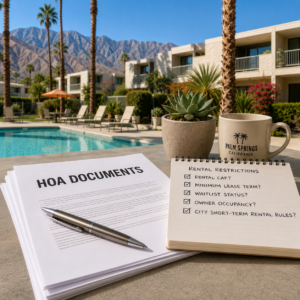 Ask for (or ensure escrow orders) the HOA documents as early as possible, including:
• CC&Rs (Covenants, Conditions & Restrictions)
• Bylaws
• Rules & Regulations
• Any rental policy addendum
• Recent meeting minutes (board and annual meetings)
• HOA questionnaire (if available)
What to look for inside them:
• The exact rental language: Look for terms like “lease,” “rent,” “tenant,” “occupancy,” “minimum term,” “cap,” “percentage,” “approval,” and “waitlist.”
• Approval process: Some HOAs require board approval of tenants, background checks, or a lease addendum.
• Enforcement and penalties: Fines for violations, reporting requirements, and whether the HOA actively monitors.
• Signs of change: Meeting minutes can reveal if the community is debating tightening or loosening rental rules. If you see repeated complaints about “too many rentals,” that’s a clue the rules may get stricter.
If your goal includes renting—now or later—this is not paperwork to treat as an afterthought.
4) Step 3: Confirm the current rental count and waitlist status (in writing)
A rental cap is only half the story. The other half is whether the community is currently “at cap,” and if so, what happens next.
You want to know:
• How many units are currently rented?
• What is the maximum allowed?
• Is there a waitlist?
• How long is the waitlist typically?
• Is the waitlist first-come, first-served, or discretionary?
Here’s the practical issue: In some communities, the only way to get a reliable answer is through the HOA management company or board, and the answer can change quickly.
Best practice is to request confirmation in writing (email is fine) from the HOA/management company. If you’re making an offer based on being able to rent in the future, you want documentation—not a verbal “I think it’s fine.”
Also, clarify whether the HOA issues rental “permits” or “certificates,” and whether they transfer with the unit. Many do not transfer; the new owner may have to reapply.
5) Step 4: Structure your offer to protect you (and keep you competitive)
In competitive pockets of Palm Springs and the broader Coachella Valley, buyers worry that asking questions about HOA rules will weaken their offer. The reality is you can protect yourself without making your offer messy—if you do it deliberately.
Offer-structuring tools that help:
• HOA document review contingency: Make sure you have a clear right to review and cancel based on HOA documents within your contingency period.
• Timeline management: Push for HOA docs to be ordered immediately upon acceptance (or even requested before writing, when possible). Delays can burn your contingency window.
• Targeted verification: If your primary goal is future rental use, your agent can communicate that you need confirmation of rental eligibility and current cap status early.
• Plan B language (where appropriate): If the cap is full, you may still proceed if you’re comfortable using the condo strictly for personal use, or if you’re comfortable joining a waitlist. But that should be your decision, not a surprise.
The goal is not to “over-contingency” the deal. The goal is to make sure you’re not buying a condo that conflicts with your intended use.
6) Step 5: Decide whether the condo still fits your goals
Once you know the facts, the decision becomes clearer. Here are common buyer profiles and how a rental cap affects them.
A) Primary residence buyers
If you’re buying to live in the condo full-time, a rental cap may not matter much—except that it can influence the community feel. Communities with fewer rentals often feel quieter and more owner-occupied.
B) Snowbirds and part-time owners
If you plan to use the condo seasonally and rent it out during the months you’re away, the details matter. A minimum lease term might still work for you, but a full rental cap with a long waitlist may not.
C) Future flexibility buyers
Many buyers in Palm Desert, Indian Wells, and Rancho Mirage want a “just in case” option: maybe you won’t rent for years, but you want the ability later. In that case, focus on whether the cap is currently full and how the HOA historically manages the waitlist.
D) Investment-minded buyers
If rental income is a key part of the purchase decision, you need to treat rental eligibility like a core due diligence item—right alongside financing and inspections. If the cap is full and the waitlist is uncertain, it may be smarter to keep looking.
A local note for Coachella Valley condo buyers
Across Palm Springs, Palm Desert, Rancho Mirage, La Quinta, Indio, and Sun City Palm Desert, condo communities can vary widely—even within the same neighborhood. Two similar-looking communities can have completely different rental rules.
That’s why the “right” condo isn’t just about the unit. It’s also about the HOA’s governing documents and how they’re enforced.
Practical checklist: what to do this week if you’re condo shopping
If you’re actively looking right now, here’s a simple action list:
1) Before you fall in love with a unit, decide your real rental goal (never, maybe later, seasonal, or income-focused).
2) Ask early: “Are there rental restrictions, minimum lease terms, or a rental cap?”
3) Get HOA docs as soon as possible and search for rental language.
4) Confirm cap status and waitlist details in writing.
5) Align your offer timeline so you can verify everything within your contingency period.
Handled correctly, rental caps don’t have to derail your purchase. They just need to be verified early so your condo matches your lifestyle and long-term plan.
If you’re buying in Palm Springs or anywhere in the Coachella Valley and want a second set of eyes on HOA rental restrictions before you commit, I can help you spot the red flags and ask the right questions at the right time.
If you’re considering a condo in Palm Springs, Palm Desert, Rancho Mirage, La Quinta, Indian Wells, Indio, or Sun City Palm Desert and rental flexibility matters, contact Brenda Devlin, Realtor, to review the HOA documents and rental restrictions before you remove contingencies. https://brendadevlin.com/





[…] is a condo, confirm whether its rental rules affect the buyer’s plans. Brenda’s guide to HOA rental caps in Palm Springs condos shows the restrictions an investment-minded buyer may […]